
















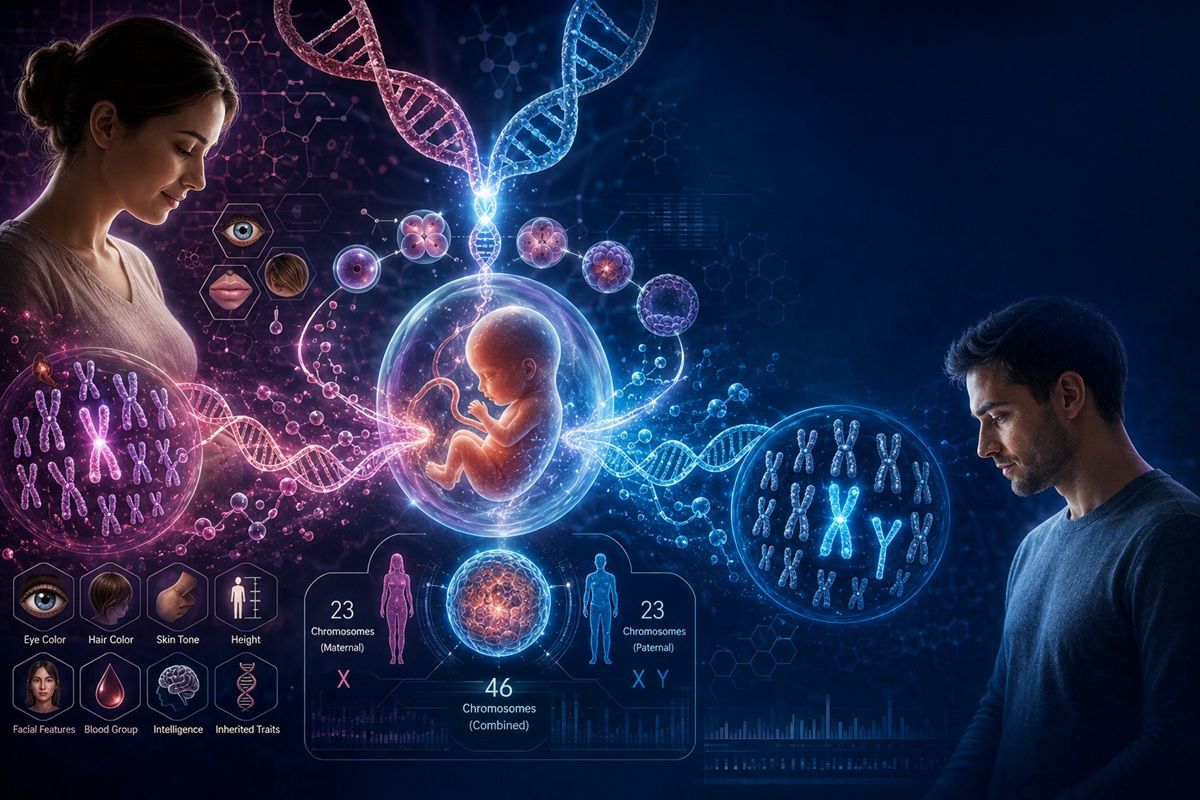
Characteristics from mother and father pass into a human embryo through chromosomes carried in the egg and sperm cells. Each parent contributes 23 chromosomes, which combine at fertilization to form 46 chromosomes in the embryo, carrying genes that determine traits like eye color, height tendency, blood type, and biological sex.
It’s a process most people learn about in a biology classroom and then never really think about again, until they’re expecting a child and suddenly wondering whose nose the baby got, or whether that hereditary condition on one side of the family is something to worry about. Here’s a clear, accurate walkthrough of exactly what happens genetically, from the moment of fertilization through to how specific traits actually get decided.
Key Takeaways
- Each parent contributes exactly 23 chromosomes; the embryo ends up with 46 total, arranged in 23 pairs
- Genes are specific segments of DNA located on chromosomes, and each gene can have different versions called alleles
- Biological sex is determined by the father’s contribution — an X or Y chromosome in the sperm
- Some traits follow simple dominant-recessive patterns, but most physical characteristics involve multiple genes interacting together
- Mitochondrial DNA is passed almost exclusively from the mother, separate from the nuclear DNA contributed by both parents
- Random assortment and genetic recombination during egg and sperm formation explain why siblings from the same parents can look quite different
- Epigenetic factors can influence how genes are expressed without changing the underlying DNA sequence itself
What Actually Happens at Fertilization?
Fertilization is the moment a sperm cell from the father merges with an egg cell from the mother, combining their genetic material into a single new cell called a zygote. This zygote carries the complete genetic blueprint for a new individual, built from equal genetic contributions of both parents.
Both the egg and the sperm are what biologists call haploid cells, meaning each carries only half the usual number of chromosomes — 23 instead of the standard 46 found in most other human cells. When they combine, the embryo ends up with a full set of 46 chromosomes, organized into 23 matching pairs.
Why 23 Chromosomes From Each Parent?
Human cells normally carry 46 chromosomes arranged in 23 pairs. If egg and sperm cells carried the full 46 each, fertilization would double the chromosome count every generation, which clearly doesn’t happen. A specialized cell division process called meiosis solves this by halving the chromosome number specifically in reproductive cells, keeping the total stable across generations.
Chromosomes, Genes, and Alleles: The Basic Building Blocks
Understanding inheritance gets much easier once these three terms are clear, since they’re often used loosely but actually mean distinct things.
| Term | What It Actually Means |
|---|---|
| Chromosome | A tightly coiled structure made of DNA, carrying many genes along its length |
| Gene | A specific segment of DNA that codes for a particular trait or function |
| Allele | A specific version of a gene — for example, one allele for brown eyes, another for blue |
Every embryo receives one copy of each gene from the mother and one from the father, meaning every trait technically has two alleles behind it, even if only one is visibly expressed.
Dominant and Recessive Traits: How the “Winning” Characteristic Gets Chosen
Some traits follow a fairly straightforward inheritance pattern, where one allele is dominant and effectively overrides a recessive allele when both are present.
- If a child inherits a dominant allele from one parent and a recessive allele from the other, the dominant trait is usually the one that shows up physically
- A recessive trait only appears if the child inherits the recessive allele from both parents
- This is exactly why two brown-eyed parents can sometimes have a blue-eyed child, if both parents happen to carry a hidden recessive allele for blue eyes
It’s Rarely This Simple in Practice
Classic dominant-recessive examples like eye color are useful for teaching the basic concept, but real inheritance patterns for most traits are considerably more complex. Height, skin tone, and facial features typically involve dozens of genes interacting together, rather than a single gene pair with a clean dominant-recessive relationship.
How Is Biological Sex Determined?
Biological sex comes down entirely to one specific chromosome pair — the X and Y chromosomes. The mother always contributes an X chromosome through the egg, since she carries two X chromosomes herself. The father can contribute either an X or a Y chromosome through the sperm, since he carries one of each.
- If the sperm carrying an X chromosome fertilizes the egg, the resulting embryo is XX, typically developing as biologically female
- If the sperm carrying a Y chromosome fertilizes the egg, the resulting embryo is XY, typically developing as biologically male
Expert tip: This is exactly why biological sex is genetically determined by the father’s contribution, not the mother’s — a common misconception worth clearing up when this topic comes up in casual conversation.
Why Do Siblings From the Same Parents Look Different?
This question comes up constantly, and the answer lies in two genetic processes that happen during egg and sperm formation.
Genetic Recombination (Crossing Over)
Before eggs and sperm are fully formed, paired chromosomes physically exchange small segments of genetic material with each other, in a process called crossing over. This shuffles the genetic material into new combinations before it’s ever passed on, meaning no two eggs or sperm from the same parent carry identical genetic content.
Random Assortment
During meiosis, which chromosome from each pair ends up in a particular egg or sperm cell is essentially random. With 23 chromosome pairs involved, this randomness alone creates over 8 million possible chromosome combinations per parent, before recombination is even factored in.
Combine both processes across two parents, and it becomes clear why siblings can differ noticeably in appearance, despite sharing the same mother and father.
Mitochondrial DNA: The Exception That’s Inherited Only From Mothers
Nearly all genetic material discussed so far comes from the cell nucleus, contributed roughly equally by both parents. Mitochondrial DNA is a distinct exception.
- Mitochondria are small structures inside cells responsible for producing energy, and they carry their own small set of DNA, separate from the nuclear DNA in chromosomes
- Egg cells contain mitochondria, while sperm cells contribute almost none to the fertilized embryo
- As a result, mitochondrial DNA is passed down almost exclusively through the mother’s line, generation after generation
This maternal-only inheritance pattern is actually used in genetic genealogy research to trace maternal ancestry lines across many generations.
Do Genes Explain Everything, or Does Environment Play a Role Too?
Genes set the blueprint, but they don’t tell the entire story on their own. Epigenetics is the study of how genes get switched on or off, or expressed more or less strongly, without any change to the underlying DNA sequence itself.
Factors like maternal nutrition during pregnancy, exposure to certain environmental conditions, and even stress levels can influence how genes are expressed in a developing embryo, layered on top of the genetic blueprint inherited from both parents.
Pros and Cons of How This Genetic System Works
Advantages of This Inheritance Process
- Genetic diversity from recombination and random assortment helps protect populations against disease vulnerability
- Combining genes from two parents generally increases genetic variety compared to asexual reproduction
- Recessive traits being “hidden” in one generation can preserve genetic diversity that resurfaces later
Drawbacks and Limitations
- Recessive genetic disorders can pass undetected through a family for generations before appearing
- Complex, multi-gene traits are difficult to predict with full accuracy, even with genetic testing
- Certain inherited conditions linked to specific chromosome combinations can’t currently be prevented, only identified early through screening
Common Mistakes People Make When Thinking About Inheritance
- Assuming a single gene controls complex traits like height or intelligence, when most involve many genes working together
- Believing the mother determines a baby’s sex, when it’s actually determined by the father’s sperm contribution
- Confusing dominant traits with “stronger” or “more common” traits, when dominance is purely about which allele is expressed, not which is biologically superior
- Overlooking mitochondrial DNA as a separate inheritance pathway distinct from nuclear chromosomal DNA
Best Practices for Understanding Family Genetic History
- Talk to a genetic counselor if a hereditary condition runs in either side of the family, especially before or during pregnancy planning
- Keep a record of known family health conditions across at least two to three generations, since patterns often only become clear over time
- Remember that genetic testing can identify risk factors, but most traits still involve some degree of environmental influence alongside genetics
Frequently Asked Questions
Do children inherit more traits from their mother or father?
Neither parent contributes more nuclear genetic material than the other — each provides 23 chromosomes. The one exception is mitochondrial DNA, which comes almost entirely from the mother.
Can a child have a trait that neither parent visibly shows?
Yes. If both parents carry a hidden recessive allele for a trait without expressing it themselves, their child can inherit both recessive copies and display the trait, even though neither parent visibly shows it.
Is intelligence inherited directly from parents?
Intelligence involves many genes interacting with environmental factors like nutrition, education, and upbringing. It isn’t controlled by a single inherited gene, and no simple prediction can be made from parental traits alone.
Why do identical twins look exactly alike if genetics involves randomness?
Identical twins form when a single fertilized egg splits into two embryos, meaning both twins share the exact same genetic material from that one fertilization event, bypassing the usual randomness involved in separate egg and sperm combinations.
Can genetic characteristics skip a generation?
Yes, particularly with recessive traits. A grandparent might show a recessive trait, a parent might carry the allele without displaying it, and a grandchild might then display the trait again if it pairs with another recessive allele.
Conclusion
Every characteristic passed into a human embryo traces back to a precise, well-understood genetic process — 23 chromosomes from each parent combining at fertilization, genes and alleles determining specific traits, and processes like recombination and random assortment ensuring no two siblings inherit an identical genetic combination. Mitochondrial DNA adds a maternal-only exception to this otherwise balanced system, and epigenetic factors layer environmental influence on top of the inherited blueprint.
Understanding this process doesn’t just satisfy classroom curiosity. It genuinely helps explain family resemblances, hereditary health patterns, and why every child, even from the same two parents, turns out to be a genuinely unique combination of both.